

When Luigi Mangione murdered CEO of UnitedHealthcare, Brian Thompson, last year, I could frame my reaction in the same words that several commentors, US officials and indeed Keir Starmer used to position themselves, quite awkwardly, on the US kidnapping of Nicolas Maduro last weekend. That is to say, I would “shed no tears” over his passing. By coincidence, Maduro and Mangione are being held in the same jail.
A wide cohort of my fellow leftists are sympathetic, if not outright supportive of Mangione, a sufferer of chronic back pain who took it upon himself to kill one of the highest-ranking corporate executives in the US healthcare system, which is extractive by design and leaves millions of the poorest Americans without adequate care. If I am being truthful, I also admit to feeling a twisted righteousness that some of that suffering was, for once, travelling in the opposite direction. Not being able to square that within my own moral framework, there’s an attraction in ducking a position and instead retreating to a simple, noncommittal: “well, I won’t shed a tear for Brian Thompson”.
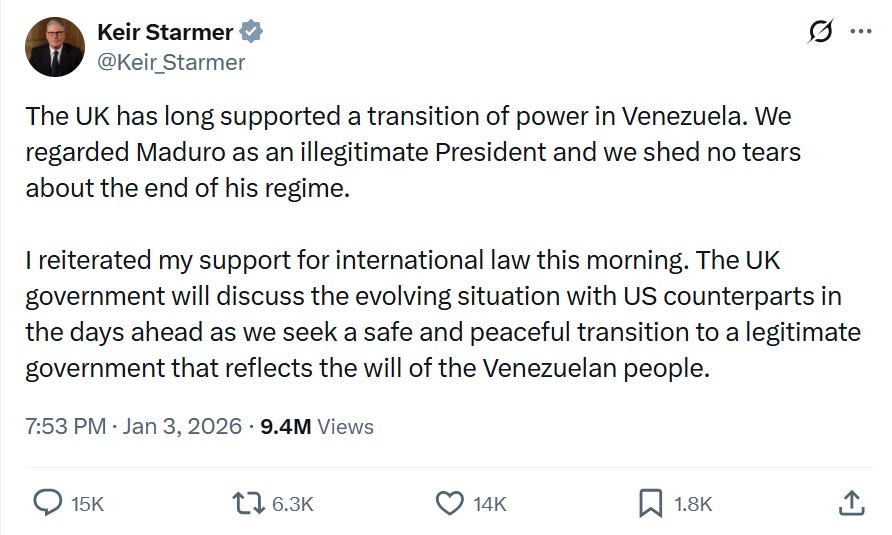
The most frequent apology I read for US’s military intervention in Venezuela is that Maduro was a bad man, his regime a bad regime, and while we cannot reconcile the unprovoked decapitation of a foreign government within the existing framework of international law, we should not mourn a regime under which eight million Venezuelans have fled the country and most of the remainder live in hardship, with no peaceful recourse to any alternative government. So, maybe it’s fine..? And in any case, it’s happened now. Let’s not provoke the Donald.
The problem with this line of argument is that, practically, law only has force if it commands the approval of all those actors you wish to be bound by it. This applies especially in the international sphere, where law is essentially a voluntary system of norms with no binding mechanisms of enforcement. As such, you cannot excuse yourself from rules to which you have agreed, even where the outcomes of doing are good and your reasons just (neither of which are remotely guaranteed in this case, btw), because ideological diversity between states means they all have their own self-justifying exceptions to which they can appeal.
China has reasons for invading Taiwan and Tibet, which can be justified in terms found in Chinese ideology. Russia has reasons for invading Ukraine and Georgia, which can be justified in terms found in Russian ideology. Even if we believe that Western ideology is just and correct (which in any case, is not the US’s primary motivation), there is no workable international norm of nonaggression which would allow one ideological deviation but not the others.
It is perfectly possible that there are some people, such as Brian Thompson or Nicolas Maduro, that the world would be better off without, and even some that morally deserve to die. But laws against murder do not permit such judgements, they apply in fairly blunt and blanket fashion because it is not possible to sustain a peaceful and ordered society where everyone is permitted to pursue their own discretionary justice against people they think ought to die. Instead, we choose a society in which many bad people live, and prosper, often at the expense of others, but interpersonal and organised violence is heavily regulated and discouraged.
US exceptionalism is thus only admissible from two further positions. First, that international law is a sham not worth honouring and everyone should just give it up. Second, that the US should treat international law entirely strategically, and disobey it only as far as is advantageous, according to its estimations of the gains and costs incurred by noncompliance. It is reasonable to think that the departure of the Trump administration from preceding US administrations can largely be understood as a shift from the second position to the first.
Starmer and his European counterparts seem to imagine that they still face a similar choice: between degrading international law and degrading the mythical special relationship. But the thing about the US obviously not caring what you do or say is that it cuts both ways: the Trump administration is probably as indifferent to British criticism and rebuke as it is to British advice, influence and endorsement. Moreover, the UK is decreasingly a big country that mulls whether to comply (or not) with international law and increasingly a mid-size country that will have to appeal to it. Without taking a view on the prospects for invasion, some significant violation of international law with respect to Greenland now seems highly likely, and in the event, it would be advantageous if the UK could do more than announce that it would now “shed some tears”.